Sign Language Translator
A 100 % test set built from 1,704 photos; robustness curves show what a webcam does to it, and how augmentation helps except under blur.
Reads the 24 static letters of the American Sign Language alphabet from a hand image, and types words from a webcam: MediaPipe finds the hand, a small CNN trained from scratch reads the letter. The headline accuracy is 99.9 %, and the interesting part of this project is showing why that number says much less than it seems: the test set is too easy, and simple camera changes break the model.
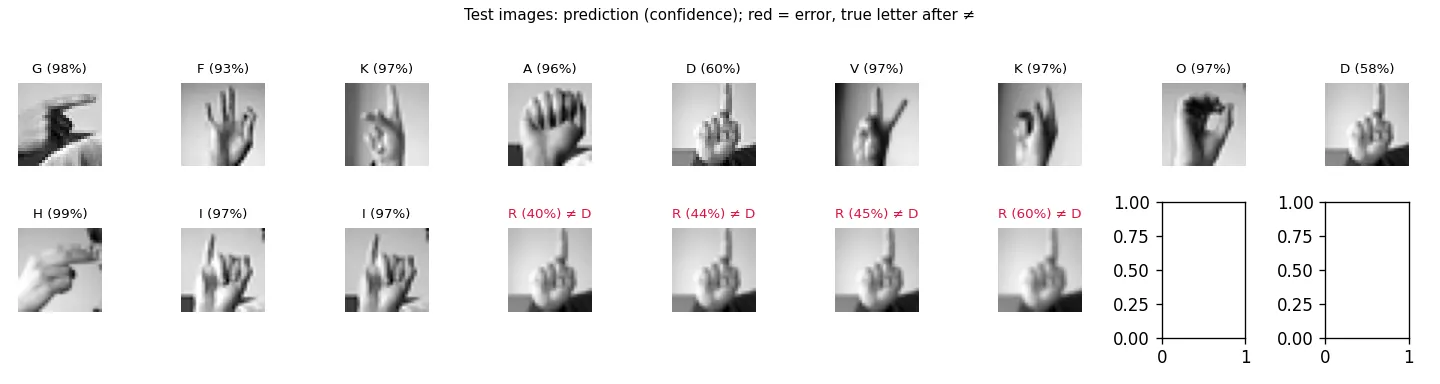
Results
7,172 official test images, 24 letters (J and Z are left out because they need motion).
| Model | Test accuracy | Macro F1 |
|---|---|---|
| Logistic regression on raw pixels (baseline) | 69.7 % | 0.673 |
| CNN from scratch, no augmentation | 100.0 % | 1.000 |
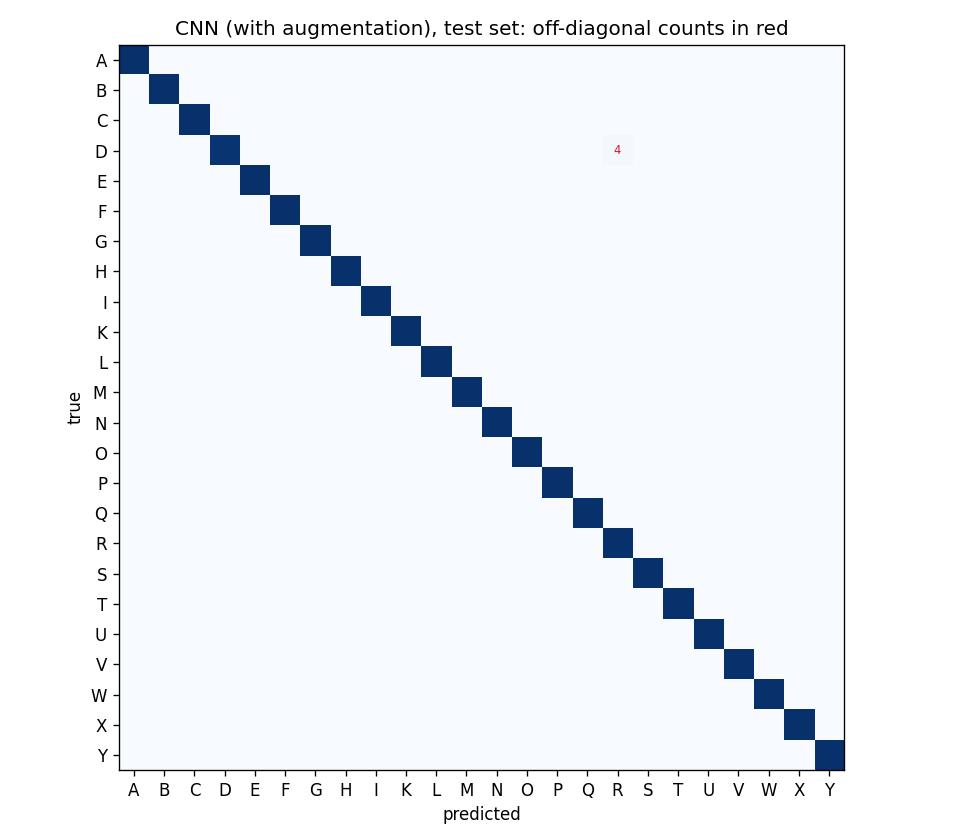
| CNN from scratch, with augmentation (used by the app) | 99.9 % | 0.999 |
The CNN has ~0.4 M parameters and trains in ~8 minutes on a laptop CPU.
Why 100 % is suspicious: the test set is not new
According to the dataset card, all 34,627 images were generated from only 1,704 original photos, each expanded into 50+ variations (resampling filters, pixelation, ±15 % brightness, 3° rotation), then split into train and test. I measured how close each test image is to its most similar training image (pixel correlation):
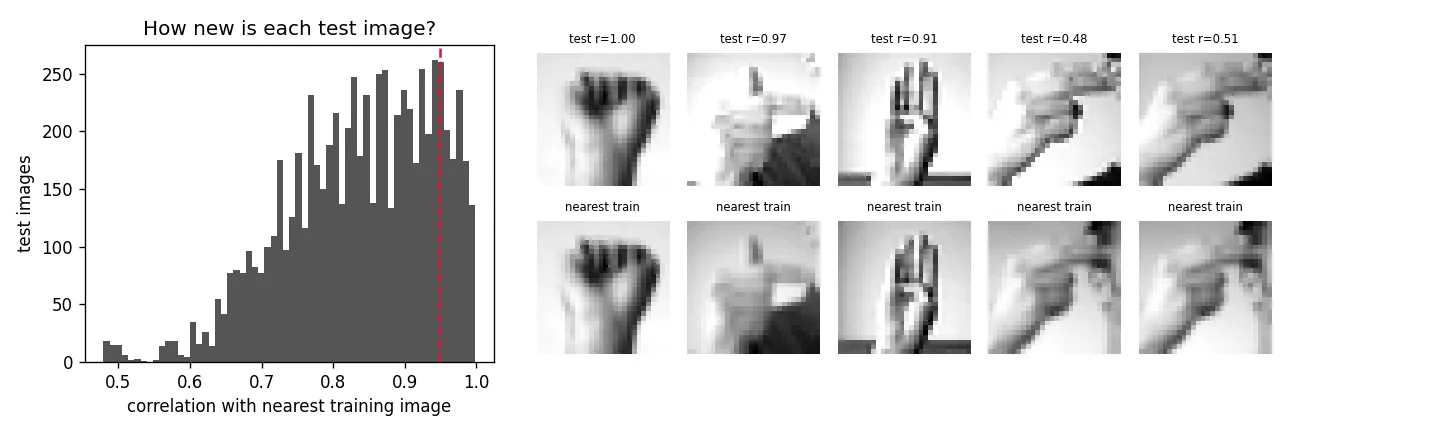
| Test images, by similarity to the nearest training image | Share | Pixel baseline | CNN |
|---|---|---|---|
| Near-duplicate (r ≥ 0.95) | 15 % | 98.9 % | 100 % |
| Similar (0.90–0.95) | 18 % | 91.6 % | 100 % |
| Not close in pixels (r < 0.90) | 67 % | 57.4 % | 99.9 % |
A third of the test set is a near copy of training data: even a linear model on raw pixels scores ~99 % there. The CNN stays perfect on the rest too, and the figure shows why: the least similar test images (r ≈ 0.5, right) are still the same photo as their nearest training image, just shifted and cropped. Pixel correlation underestimates the overlap. The test set cannot tell us how the model does on a new person or a new room.
What a webcam does to it: robustness
Same test images, perturbed the way a real camera would (borders filled by repeating the edge):

| Perturbation | No augmentation | With augmentation |
|---|---|---|
| Rotation 20° / 30° | 75.1 % / 38.3 % | 96.5 % / 71.7 % |
| Shift 4 px / 6 px (of 28) | 61.6 % / 26.4 % | 92.4 % / 53.2 % |
| Scale 0.8× / 1.2× | 91.8 % / 96.2 % | 96.4 % / 99.8 % |
| Brightness 0.4× / 1.6× | 89.1 % / 93.4 % | 99.9 % / 96.7 % |
| Blur σ 1.5 px / 2 px | 68.1 % / 35.6 % | 45.0 % / 23.0 % |
- Augmentation is what makes the model usable: identical clean accuracy (99.9 % vs 100 %), but 2× more accurate on a 30° tilt or a 6-pixel shift. The clean test set alone would have hidden this completely.
- Augmentation only protects against what it includes. It had no blur, and the augmented model is worse under blur than the plain one: it learned to rely on fine edges that survive rotation but not defocus. A webcam image is often slightly blurred, so the next training run should add blur and noise.
How it works
- Data (
asl.py): 28×28 grayscale crops, labels 0–25 mapped to 24 classes (no J, no Z). - Model: three conv blocks (two 3×3 convs + batch norm + ReLU, then max-pool: 28 → 14 → 7 → 3), dropout, two dense layers. Trained from scratch, AdamW + one-cycle schedule, label smoothing 0.05, 8 epochs.
- Augmentation (
train.py --aug): per-image random rotation ±12°, shift ±10 %, scale 0.9–1.1, brightness and contrast ±30 %. - Evaluation (
evaluate.py): accuracy and macro F1 against a pixel logistic-regression baseline, the leakage audit, robustness curves, confusion matrix (docs/confusion_matrix.png). - Webcam app (
app.py): MediaPipe Hand Landmarker gives the hand’s landmarks; their bounding box (+25 % margin) is cropped, converted to the dataset’s format (grayscale, padded to a square with the background tone, 28×28) and classified. A letter is typed when it stays the top prediction (≥ 80 %) for 12 frames; no hand for 1.5 s types a space.
Data
- Sign Language MNIST (Kaggle
datamunge/sign-language-mnist), CC0: 27,455 train / 7,172 test images, 28×28 grayscale. - Location:
../../cv-data/asl/(not committed).
Run it
.venv\Scripts\activate            # shared environment, from the repo root
cd 05-sign-language-translator
kaggle datasets download datamunge/sign-language-mnist -p ../../cv-data/asl --unzip
python train.py --aug             # ~8 min on CPU → cnn_aug.pt
python train.py                   # the no-augmentation ablation → cnn_noaug.pt
python evaluate.py                # ~15 min: metrics, leakage audit, robustness, figures
python app.py                     # webcam translator (Esc to quit)
What I learned / what didn’t work
- A perfect score was a warning, not a result. The dataset card explains it: 1,704 photos stretched into 34,627 images. Measuring robustness told me more about real-world use than the test set did.
- Validation was useless for model selection (100 % from epoch 3): it is drawn from the same training CSV. A split by original photo is impossible because the dataset does not record which photo each image came from.
- Augmentation is a specification. Every transformation I included made the model robust to it; the one I left out (blur) got worse.
- The webcam app is not measured. There is no labeled webcam data here; its accuracy on a new signer is unknown and probably far below the test numbers. That is the honest status of this demo.
Next steps
- Add blur, noise and JPEG compression to the augmentation; re-measure the robustness curves.
- Record a small labeled set of webcam images from new signers to measure real accuracy.
- Classify MediaPipe hand landmarks instead of pixels: invariant to background, lighting and skin tone, and J/Z become possible with a sequence model over landmark trajectories.
Tech stack
Python · PyTorch · torchvision · scikit-learn · OpenCV · MediaPipe · Matplotlib