Retail Shelf Monitor
YOLO11n counts every product on dense supermarket shelves. Retraining on all 8,185 SKU-110K images on a Kaggle GPU raised mAP50 from 0.838 to 0.927 and cut count error from 13.3 % to 10.3 % on the same 488 test shelves.
Detects and counts every product on a supermarket shelf photo, where a single image can hold 100–700+ tightly packed items, and flags possible empty facings. YOLO11n fine-tuned on a laptop CPU with only 219 training photos from the SKU-110K benchmark.
Example images not shown: the dataset licence (SKU-110K, CC BY-NC 2.0) does not allow redistribution; see the dataset page.
Green: detected products. Red: spots flagged as possibly empty by a simple rule. Many red boxes are actually missed products, see below.
Results
488 test shelf photos (SKU-110K validation shard, never seen in training): 76,083 products.
Detection
| Metric | Value |
|---|---|
| mAP50 | 0.838 |
| mAP50-95 | 0.487 |
| Precision / recall | 0.842 / 0.766 |
| Inference (CPU, 960 px) | 128 ms per image |
For context, the original SKU-110K paper (Goldman et al., CVPR 2019) reports about 0.49 AP (0.5:0.95) for its method, trained on ~8,000 images on a GPU. This model trained on 219 images on a CPU. Image sizes and protocol differ, so it’s a sanity check, not a head-to-head comparison.
Counting
| Metric | Value |
|---|---|
| Products per image (true) | mean 155.9, max 718 |
| Mean absolute count error | 22.1 products |
| Mean relative count error | 13.3 % |
| Bias (predicted − true) | −12.7: it under-counts |
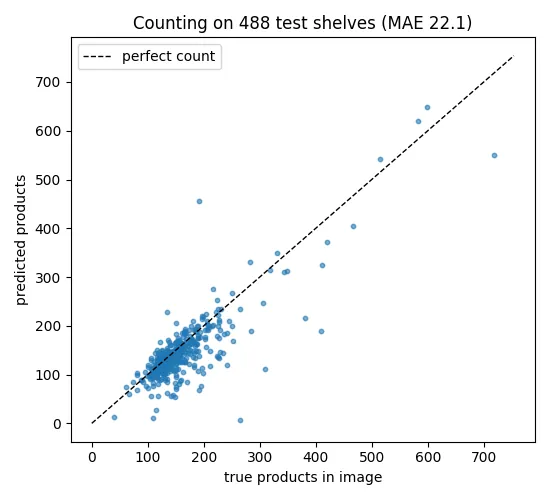
Retrained on all the data (Kaggle GPU)
The model above was trained on a laptop CPU with 219 images (30 epochs). The same YOLO11n, same 960 px and
max_det=1000, was retrained on the full official SKU-110K train split (8,185 images) for 40 epochs on a free
Kaggle GPU (~3.6 h; kaggle_train_full.py). Model selection used 499 images of the
official test split, so the 488 local test images (official validation split) were never seen. Evaluated here
on the same 488 test images (python evaluate.py --model full):
| Row | Laptop CPU, 219 images | Kaggle GPU, 8,185 images |
|---|---|---|
| mAP50 / mAP50-95 | 0.838 / 0.487 | 0.927 / 0.580 |
| Precision / recall | 0.842 / 0.766 | 0.907 / 0.865 |
| Count MAE / relative error | 22.1 / 13.3 % | 17.0 / 10.3 % |
| Bias (predicted − true) | −12.7 | −10.2 (still under-counts) |
| Images with flagged “gaps” | 401 / 488 | 376 / 488 |
| CPU inference (960 px) | 128 ms / image | 141 ms / image (same network) |
More data mostly bought recall (+10 points), which is what the counting and gap rule needed. The model still under-counts on the most crowded shelves, and the gap rule still fires on most images, so most “gaps” remain missed products rather than real empty facings.
How it works
- Data prep (
prepare.py): SKU-110K parquet shards (COCOxywhboxes) are exported to the YOLO layout. Photos (up to 2340×4160) are shrunk to a max side of 1,280 px. - Training (
train.py): YOLO11n from COCO weights, 960 px input (products are small), 30 epochs (~1.6 h on CPU), andmax_det=1000. YOLO’s default cap of 300 detections per image would silently cut off a 700-product shelf. - Counting: number of detections above 0.35 confidence per image, compared with the true box count.
- Empty-facing rule (
evaluate.py): products are grouped into shelf rows by their vertical position; a horizontal gap wider than 1.5× the median product width between neighbors in a row is flagged.
Data
- SKU-110K (Goldman et al., CVPR 2019), from the parquet mirror
finedet/sku110k(CC BY-NC 2.0, non-commercial). Used: training shard 8 of 9 (219 images, 31,394 boxes) and the validation shard (100 images for validation, 488 for test). The full dataset is ~11,700 images / 13 GB. - Location:
../../cv-data/shelf/(not committed).
Run it
.venv\Scripts\activate            # shared environment, from the repo root
cd 09-retail-shelf-monitor
python prepare.py
python train.py --epochs 30       # ~1.6 h on CPU; --resume continues an interrupted run
python evaluate.py                # mAP, counting error, examples
What I learned / what didn’t work
- Dense scenes need two settings changed: a larger input size (small objects) and a higher
max_det(YOLO’s default would make counting impossible on large shelves). - The empty-facing rule mostly finds missed products. It flagged gaps in 401 of 488 images: with 23 % of products undetected (recall 0.77), a missed item looks exactly like a hole. Real gap detection needs either much higher recall or labeled “empty facing” examples. SKU-110K has none, so the rule stays a demo.
- Under-counting comes from the same source. Missed products in crowded or hanging displays (left example: 138 of 224) pull the count down; more training data is the obvious fix (8 more shards available).
- Validation and test agree (val mAP50 0.849 at the last epoch, from the training log
../../cv-data/shelf/outputs/runs/yolo11n_shelf/results.csv, vs test 0.838), so the 100-image validation set wasn’t misleading.
Next steps
- Train on more shards (and longer) to raise recall; then revisit gap detection.
- Label a few hundred empty facings and train a dedicated “gap” class.
- Planogram compliance: match detected positions against the expected layout.
Tech stack
Python · Ultralytics YOLO11 · pyarrow · OpenCV · NumPy · Matplotlib