PPE Safety Monitor
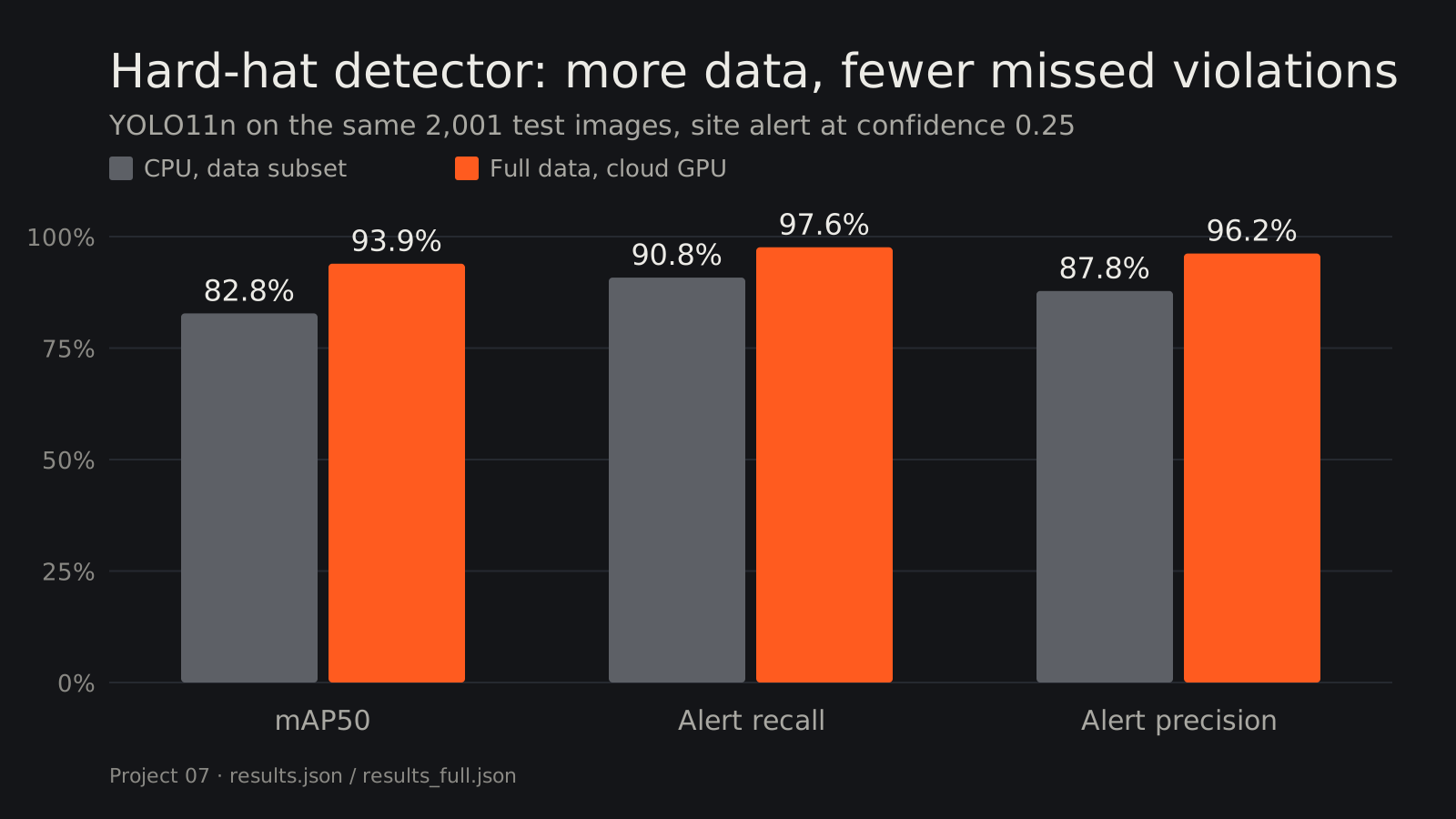
Hard-hat detector with alert-level metrics; retraining on all 13.8k images (Kaggle GPU) cut missed violations by 74 %.
Detects every head in an image as wearing a hard hat or not, and raises a site alert when anyone is missing one. YOLO11n (COCO-pretrained) fine-tuned on a laptop CPU; evaluated both as an object detector (mAP) and as the alert a safety manager would actually receive.
Example images not shown: the dataset licence (Roboflow CC BY 4.0, but the source photos carry third-party watermarks) does not allow redistribution; see the dataset page.
Top: images with violations, where the alert fires. Bottom: compliant images, with hard hats detected (green).
Results
Full test split: 2,001 images.
Object level
| Class | AP50 | AP50-95 |
|---|---|---|
| hardhat | 0.846 | 0.439 |
| no-hardhat | 0.809 | 0.475 |
| mean | 0.828 | 0.457 |
Inference: ~51 ms per 640×640 image on CPU.
Site-alert level
Ground truth per image: “is at least one person missing a hard hat?” (413 of 2,001 images). The alert fires when the model sees any “no-hardhat” head above the confidence threshold.
| Confidence threshold | Alert precision | Alert recall (violations caught) | Missed violations | False alarms |
|---|---|---|---|---|
| 0.25 | 87.8 % | 90.8 % | 38 | 52 |
| 0.40 | 92.0 % | 83.1 % | 70 | 30 |
| 0.50 | 95.8 % | 77.0 % | 95 | 14 |
| 0.60 | 97.0 % | 55.2 % | 185 | 7 |
For safety, a missed violation is worse than a false alarm, so a low threshold (0.25) is the right default: 9 in 10 violation scenes are flagged, and about 1 alert in 8 is unnecessary.
Retrained on all the data (Kaggle GPU)
The model above was trained on a laptop CPU with 1,500 of the 13,782 training images (10 epochs). The same
YOLO11n, same classes, same 640 px, was retrained on all 13,782 images for 50 epochs on a free Kaggle T4 GPU
(1.7 h; kaggle_train_full.py), then evaluated here on the same 2,001 test images:
| Row | Laptop CPU, 1,500 images | Kaggle GPU, 13,782 images |
|---|---|---|
| mAP50 / mAP50-95 | 0.828 / 0.457 | 0.939 / 0.595 |
| no-hardhat AP50 | 0.809 | 0.938 |
| Site alerts @ 0.25: recall (violations caught) | 90.8 % (38 missed) | 97.6 % (10 missed) |
| Site alerts @ 0.25: precision | 87.8 % (52 false alarms) | 96.2 % (16 false alarms) |
| CPU inference | ~51 ms / image | ~50 ms / image (same network) |
Nine times more data cut missed violations by 74 % and false alarms by 69 %, with the same small network and the same inference cost. On this task the bottleneck was data and training time, not model size.
How it works
- Data prep (
prepare.py): a random 1,500 / 300 train / validation subset is extracted straight from the downloaded zip into the YOLO layout with short file names. The full 13,782-image folder would overflow a FAT32 directory (see project 06). - Training (
train.py): YOLO11n from COCO weights, 640 px, 10 epochs on CPU (~1.4 h). Validation mAP50 rose from 0.45 after epoch 1 to 0.81 after epoch 10 and was still climbing (per-epoch values in the training log,../../cv-data/ppe/outputs/runs/yolo11n_ppe/results.csv). - Evaluation (
evaluate.py): COCO-style mAP on the test split, then image-level alerts swept over the confidence threshold.
Data
- Hard Hat Workers dataset (Roboflow, Hugging Face mirror
keremberke/hard-hat-detection): 13,782 / 3,962 / 2,001 train / valid / test images, classeshardhatandno-hardhat(head boxes). - Location:
../../cv-data/ppe/(not committed).
Run it
.venv\Scripts\activate            # shared environment, from the repo root
cd 07-ppe-safety-monitor
python prepare.py                 # extract the YOLO subset from the zips
python train.py --epochs 10       # ~1.4 h on CPU; --resume continues an interrupted run
python evaluate.py                # mAP, alert sweep, examples
What I learned / what didn’t work
- Harder than license plates. Heads are small and crowded (one image can have 20+), and helmets come in many colors and angles: mAP50 0.83 vs 0.98 for plates with the same model and training budget.
- The model was still improving at epoch 10. More epochs (and the full 13.8k training images instead of 1,500) would clearly help; CPU time was the limit.
- Many “violation” images aren’t construction sites. The dataset includes street and subway crowds with bare heads, so “no-hardhat” partly means “a visible bare head anywhere”. A real deployment should be validated on footage from the actual site.
- Report the alert, not just mAP. mAP 0.83 doesn’t tell a site manager much; “90 % of violations flagged, 1 alert in 8 unnecessary” does.
Next steps
- Train longer on the full training set (GPU), add vests and other PPE.
- Run on video with tracking (project 08) so each person triggers one alert, not one per frame.
- Auto-label new site footage with Grounding DINO (project 17), review, and fine-tune.
Tech stack
Python · Ultralytics YOLO11 · OpenCV · NumPy · Matplotlib