License Plate Recognition
YOLO11n retrained on all 6,176 images on a free cloud GPU (mAP50 0.990) + OCR; a padding fix and plate-grammar rules took reading from 0% to 90%.
Finds license plates in photos and reads them. A two-stage pipeline: YOLO11n, fine-tuned here on a laptop CPU, locates plates; RapidOCR (via OpenVINO) reads the cropped plate; a format-aware correction step fixes the classic O/0, I/1, S/5 confusions. Each stage is measured separately.
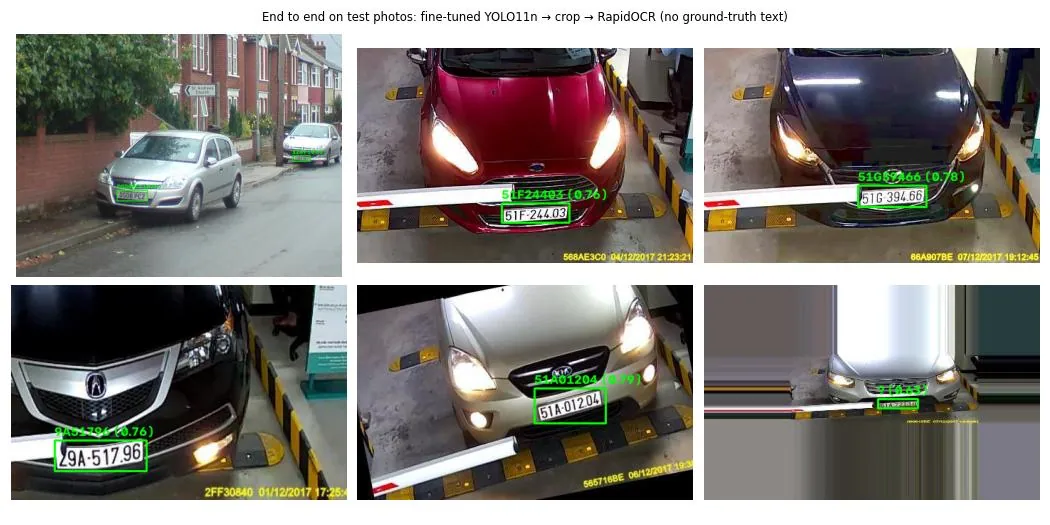
End to end on test photos: plates found and read (“51F-244.03” → 51F24403, “29A-517.96” →
29A51796). Tiny, distant plates (top left, bottom right) are found but not readable.
Results
Stage 1: detection (882 test images)
| Detector | Training | mAP50 | mAP50-95 | Precision | Recall |
|---|---|---|---|---|---|
| YOLO11n fine-tuned here | 1,500 images, 12 epochs, CPU (~2.4 h) | 0.983 | 0.686 | 0.986 | 0.957 |
| Public plate detector (morsetechlab v1n) | much larger dataset, GPU | 0.993 | 0.717 | 0.994 | 0.980 |
Fine-tuning on a quarter of the training set on a CPU gets within ~1 point mAP50 of a public model trained on far more data. Caveat: the public model may have seen images from this same Roboflow source, so its numbers could be optimistic.
Retrained on all the data (Kaggle GPU)
The detector above was trained on a laptop CPU with 1,500 of the 6,176 training images (12 epochs). The same
YOLO11n, same single class, same 640 px, was retrained on all 6,176 images for 50 epochs on a free Kaggle T4
GPU (41 min; kaggle_train_full.py), selecting on the full official valid split (1,765
images), then evaluated here on the same 882 test images (python evaluate.py --model full, numbers in
docs/results_full.json):
| Row | Laptop CPU, 1,500 images | Kaggle GPU, 6,176 images | Public model (morsetechlab v1n) |
|---|---|---|---|
| mAP50 / mAP50-95 | 0.983 / 0.686 | 0.990 / 0.717 | 0.993 / 0.717 |
| Precision / recall | 0.986 / 0.957 | 0.993 / 0.966 | 0.994 / 0.980 |
Four times the data closes most of the gap to the public detector: mAP50-95 (tighter boxes) now matches it, recall is still ~1.4 points lower. The gain is small because the CPU model was already at 0.98 mAP50; the OCR stage is unchanged (it does not depend on the detector), so reading is still the weak link.
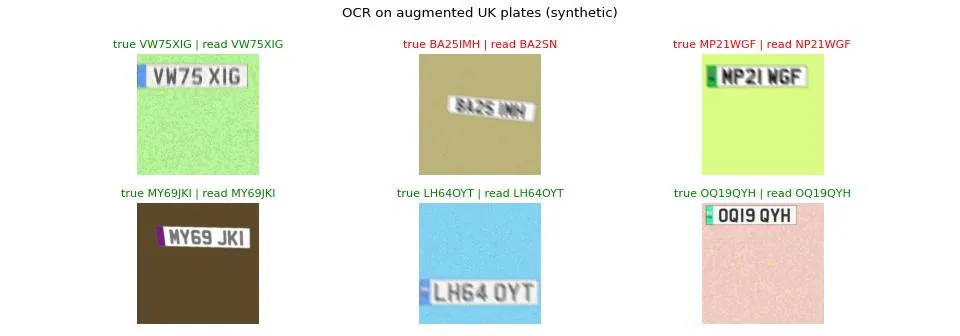
Stage 2: reading (300 UK plates with known registrations)
| Plates | Exact match (raw OCR) | + UK format correction | Character accuracy (corrected) |
|---|---|---|---|
| Clean plate crops | 61.3 % | 89.7 % | 95.0 % |
| Augmented (angle, blur, lighting, in a scene) | 50.3 % | 80.3 % | 92.4 % |
How it works
- Detection: YOLO11n starts from COCO weights and is fine-tuned on 1,500 plate images (640 px, 12 epochs). Transfer learning makes this work on a CPU: mAP50 was already 0.95 after one epoch.
- Crop + pad: each detected plate is cropped with a small margin, upscaled if small, and padded with a border.
- OCR: RapidOCR (PaddleOCR detection + recognition models running on OpenVINO) reads the text; boxes are joined left to right, non-alphanumeric characters and the “UK”/“GB” band are dropped.
- Format-aware correction: current UK plates follow
LLDDLLL(e.g.MY69JKI). With 7 characters read, positions 3–4 must be digits and the rest letters, so0→O,1→I,5→S… are corrected by position. Real ANPR systems do this with each country’s plate grammar.
The bug that mattered
The first OCR run scored 0 % exact match on clean plates but 41 % on augmented ones, which can’t
be right (clean should be easier). Looking at raw OCR output showed why: the clean plates are
tight crops with no margin, and the text detector (trained on scene text) split them into
single characters (VW7 · 75 · G) and picked up the “UK” band and stray symbols. Padding the
crop fixed it: 0 % → 61 %, and the format correction took it to 90 %.
Data
- Detection: “Vehicle Registration Plates” (Augmented Startups, via Roboflow; Hugging Face mirror
keremberke/license-plate-object-detection): 6,176 / 1,765 / 882 train / valid / test images, many of them Vietnamese plates. A random 1,500 / 300 subset was used for training / validation (CPU time); the full test split for evaluation. - Reading:
spawn99/UK-Car-Plate-VRN-Dataset(MIT): synthetic UK plates with their registration, clean and augmented. First 300 of the first shard. - Location:
../../cv-data/plates/(not committed).
Run it
.venv\Scripts\activate            # shared environment, from the repo root
cd 06-license-plate-recognition
python prepare.py                 # COCO JSON → YOLO subset (short file names)
python train.py --epochs 12       # ~2.4 h on CPU; --resume continues an interrupted run
python evaluate.py                # detection mAP, OCR accuracy, figures
The comparison model and the data (PowerShell, from this folder; prepare.py expects the zips extracted
into train/, valid/, test/ folders under ../../cv-data/plates/):
$d = "..\..\cv-data\plates"; New-Item -ItemType Directory -Force "$d\outputs" | Out-Null
Invoke-WebRequest "https://huggingface.co/morsetechlab/yolov11-license-plate-detection/resolve/main/license-plate-finetune-v1n.pt" -OutFile "$d\outputs\pretrained_plate_v1n.pt"
foreach ($s in "train","valid","test") {
  Invoke-WebRequest "https://huggingface.co/datasets/keremberke/license-plate-object-detection/resolve/main/data/$s.zip" -OutFile "$d\$s.zip"
  New-Item -ItemType Directory -Force "$d\$s" | Out-Null; tar -m -xf "$d\$s.zip" -C "$d\$s"
}
Invoke-WebRequest "https://huggingface.co/datasets/spawn99/UK-Car-Plate-VRN-Dataset/resolve/main/data/train-00000-of-00003.parquet" -OutFile "$d\uk_plates_0.parquet"
What I learned / what didn’t work
- OCR on tight crops needs padding. Text detectors are trained on text with surroundings.
- Plate grammar is worth ~30 points of exact match. Most residual errors are O/0, I/1, S/5 confusions, which positional rules fix for free.
- The OCR is trained on scene text, not plates. A recognizer fine-tuned on plate crops (or a small CRNN trained on the synthetic set) would likely beat the 80 % on augmented plates.
- Distant plates fail at the reading stage, not detection (see the demo figure). A few pixels high is too little for any OCR; higher-resolution input or super-resolution would be needed.
- The UK OCR test set is synthetic; real UK plates under real cameras would score lower. Detection was measured on real photos (mostly Vietnamese plates), reading on synthetic UK plates, so end-to-end accuracy isn’t directly measured.
- OCR timings (190–350 ms per plate) were measured while another model trained on the same CPU, so they’re pessimistic; on an idle CPU, project 03 read a whole receipt (dozens of text lines) with the same OCR in ~0.7 s.
Next steps
- Fine-tune a plate-specific text recognizer on the synthetic UK set.
- Measure end to end on a dataset with both boxes and plate text (e.g. CCPD).
- Combine with project 08 (traffic tracking): read each tracked vehicle’s plate once, keeping the most confident read across frames.
Tech stack
Python · Ultralytics YOLO11 · RapidOCR (PaddleOCR models) · OpenVINO · OpenCV · pyarrow