Fall Detection
Tells a fall from lying down on purpose using pose dynamics; threshold chosen by nested cross-validation grouped by video; trees beat a 1D-CNN and a GRU.
Detects when a person falls in a video and raises an alarm, while not alarming when they sit, crouch or lie down on purpose. Each frame is reduced to a body skeleton (YOLO11n-pose), the skeleton to posture and motion features, and a classifier decides whether a fall is happening.
Example images not shown: the dataset licence (UR Fall Detection, research use only) does not allow redistribution; see the dataset page.
Results
UR Fall Detection dataset, front camera: 30 falls and 40 daily activities, 16 of which include lying down on purpose (the hard negatives). Scored per video: did a fall raise an alarm (sensitivity), and did a non-fall stay quiet (specificity)?
| Detector | Sensitivity (falls caught) | Specificity (no false alarm) | F1 | Median alarm latency |
|---|---|---|---|---|
| Hand-written rules | 80.0 % (24/30) | 95.0 % (38/40) | 0.857 | 0.95 s |
| Learned (gradient-boosted trees, 5-fold CV), threshold fixed at 0.5 | 100 % (30/30) | 80.0 % (32/40) | 0.882 | 0.60 s |
| Learned, threshold chosen by nested CV | 96.7 % (29/30) | 95.0 % (38/40) | 0.951 | 0.70 s |
Same split for all three rows (5 folds grouped by video, shuffling seed 0); F1 counts a fall as the positive class.
Choosing the alarm threshold without peeking (nested CV)
The first version of this project reported the threshold sweep below and noted that 0.9 looked best, but 0.9 was picked after seeing the test results. The threshold is now chosen honestly: inside each training fold, a second grouped 4-fold CV produces validation probabilities for the training videos only, the threshold with the best video-level F1 on them is kept (median of the tied values, grid 0.30-0.95), and only then is it applied to the held-out fold. To see how much the numbers depend on the particular split, the whole outer CV is repeated with 5 shuffling seeds:
| Protocol (gradient-boosted trees) | Sensitivity | Specificity | F1 |
|---|---|---|---|
| Fixed threshold 0.5 (original protocol) | 99.3 % (96.7-100) | 83.5 % (80.0-85.0) | 0.898 (0.882-0.909) |
| Nested CV threshold (honest) | 93.3 % (90.0-96.7) | 96.5 % (95.0-97.5) | 0.943 (0.931-0.951) |
| Best threshold picked on the test results (optimistic, reference only) | 95.3 % (90.0-100) | 97.0 % (95.0-100) | 0.956 (0.933-0.983) |
Mean over 5 outer-CV seeds, (min-max) in brackets. 30 falls, 40 daily activities per seed.
- The nested thresholds land between 0.65 and 0.95 (most often 0.9-0.95): the inner folds agree that 0.5 is too eager. The honest F1 (0.943) is only 0.013 below the peeked one (0.956), so the earlier “~97 % caught, ~0 false alarms at 0.9” was optimistic but not by much.
- The trade-off is real: compared with 0.5, the nested threshold removes about 5 of the 6-8 false alarms per run but misses 1-3 of the 30 falls (fall-29 and fall-25 are missed most often), and the alarm comes 0.1-0.2 s later.
evaluate.pyapplies the same rule to the final model: a grouped 5-fold CV over all 70 videos picks 0.90, which is saved infall_model.jobliband used bydetect.py.
The operating curve on the seed-0 out-of-fold probabilities, for reference (descriptive, not a selection):
| Alarm threshold | Sensitivity | Specificity | F1 | Median latency |
|---|---|---|---|---|
| 0.5 | 100 % | 80.0 % | 0.882 | 0.6 s |
| 0.7 | 96.7 % | 87.5 % | 0.906 | 0.7 s |
| 0.8 | 96.7 % | 92.5 % | 0.935 | 0.7 s |
| 0.9 | 96.7 % | 100 % | 0.983 | 0.7 s |
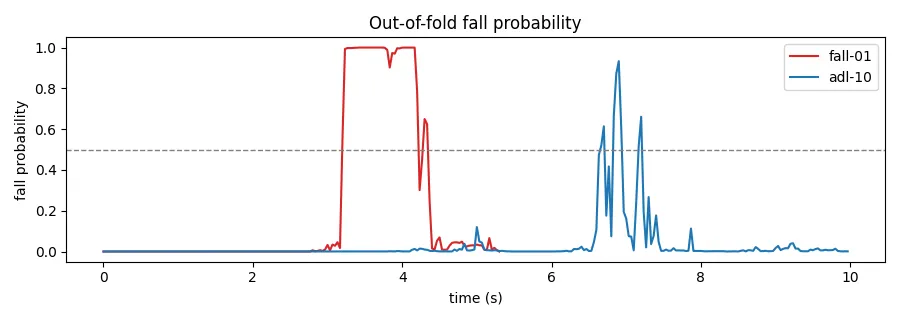
A fall (red) drives the probability to ~1.0 and keeps it there. Lying down on purpose (blue) spikes briefly but doesn’t stay above the threshold for 10 consecutive frames (0.33 s), so no alarm.
Temporal models on raw keypoints (1D-CNN, GRU): they don’t beat the trees
Instead of the 16 hand-crafted window features, a small network reads the raw skeleton sequence
(temporal_model.py, temporal.py): per frame, the 17 keypoints
(x, y, confidence), the box, a detection flag and their velocities (94 numbers), standardised on the
training fold. Two causal architectures (they only see the past, so they could run online like the
trees): a 1D-CNN (dilated causal convolutions, 32 channels, 2.1 s receptive field, ~19 k
parameters) and a GRU (48 units, ~19 k parameters). Trained from scratch on CPU with weighted BCE on random 5 s
windows, mirrored copies of the training videos and input noise, 600 steps. Evaluated with exactly the
same protocol as the trees: same outer folds per seed, same nested threshold choice, same alarm rule.
| Model (outer seeds 0, 1, 2) | Sensitivity | Specificity | F1 | Median latency |
|---|---|---|---|---|
| Gradient-boosted trees, hand-crafted features | 94.4 % (93.3-96.7) | 96.7 % (95.0-97.5) | 0.950 (0.949-0.951) | 0.72 s |
| 1D-CNN, raw keypoints | 93.3 % (90.0-96.7) | 95.0 % (92.5-97.5) | 0.933 (0.900-0.967) | 0.33 s |
| GRU, raw keypoints | 88.9 % (83.3-96.7) | 94.2 % (92.5-95.0) | 0.903 (0.877-0.951) | 0.38 s |
| 1D-CNN, the same 16 hand-crafted features as the trees | 90.0 % (83.3-96.7) | 95.0 % (92.5-97.5) | 0.915 (0.862-0.951) | 0.47 s |
Nested-CV threshold for every row; mean over 3 outer seeds, (min-max) in brackets; latency = mean of the per-seed medians.
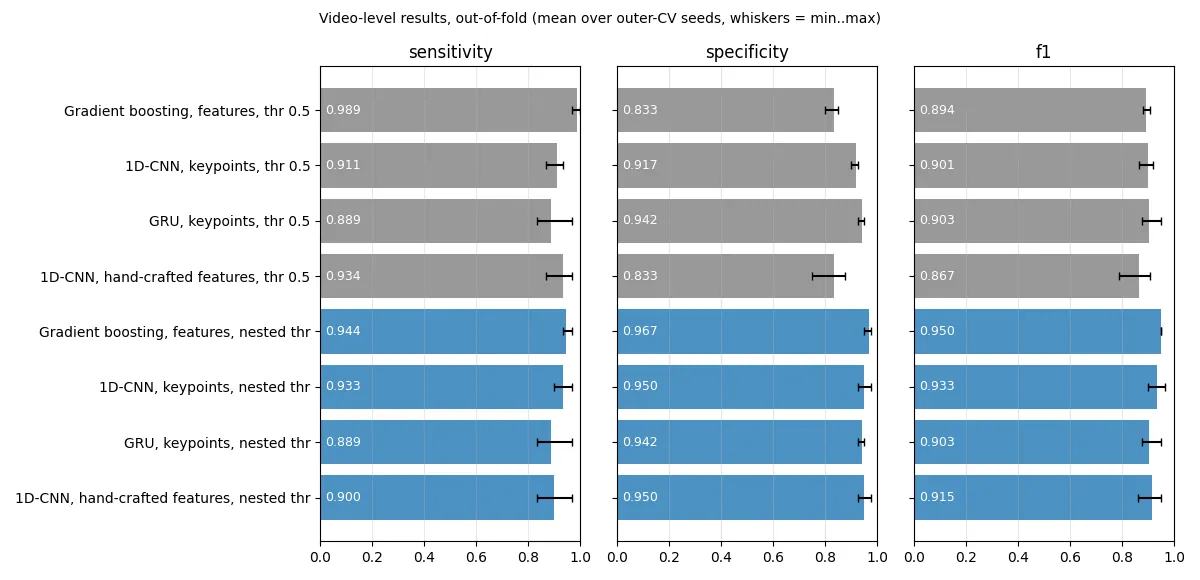
Grey: threshold fixed at 0.5. Blue: threshold chosen by nested CV. Whiskers: min-max over the 3 outer seeds.
- The trees stay best on average and are far more stable (F1 0.949-0.951 across splits vs 0.900-0.967 for the 1D-CNN). With 56 training videos per fold, of which 24 falls, a network that must discover “fast descent then horizontal” from raw coordinates has little to learn from; the hand-crafted features hand it that knowledge. The 1D-CNN did win on one split (0.967 vs 0.949), so “worse” here means “worse on average and noisier”, not “always worse”.
- The networks raise the alarm about twice as fast (median ~0.33 s after the labelled onset vs ~0.7 s): they react to the first frames of the drop instead of waiting for the posture features to turn horizontal. For a real alarm that matters less than missing a fall, but it is a genuine strength.
- They make different mistakes. The trees’ false alarms are adl-16, adl-32 and adl-39; the networks’ are adl-26 and adl-37, and both networks miss fall-13 and fall-07 in most runs. That makes an ensemble a natural next step (not tried here).
- It isn’t only the inputs. Fed the trees’ own 16 features, the same 1D-CNN does worse than on raw keypoints (F1 0.915, 0.862-0.951): with this little data, gradient-boosted trees simply fit tabular features more reliably than a network trained from scratch.
- The GRU’s probabilities are almost binary: its nested threshold changes nothing compared with 0.5 (identical results on all 3 seeds), so threshold tuning can’t trade its misses for false alarms.
- Cost: one network fit took 17 s on an idle CPU and up to 2 min while the laptop was busy, ~25 fits per seed with the inner CV (up to ~2.5 h for 3 seeds); the trees train in seconds.
How it works
- Pose: YOLO11n-pose finds the largest person in each frame and their 17 body keypoints.
- Features (
fall.py), per frame:- Posture: torso angle from vertical (shoulders vs hips), bounding-box aspect ratio, head/hip height.
- Dynamics: how fast the head and box top moved down, how fast the torso tilted, and the maximum of those over the last 1.5 s; current height relative to the last 2 s.
- Rule baseline: alarm if the body is horizontal (torso > 55° or box wider than tall) AND a fast descent happened in the last 1.5 s, for 5 consecutive frames (the learned model below uses 10, so the comparison isn’t perfectly like-for-like: the rule is given the faster trigger).
- Learned model: gradient-boosted trees predict, per frame, “a fall is happening or just happened”. Training target = the fall plus the 2 s after it began; every frame of a daily activity is negative, including deliberate lying down.
- Alarm: probability above the threshold for 10 consecutive frames (0.33 s). This filters
one-frame spikes. The threshold is chosen by an inner cross-validation on training videos only
(
protocol.py: alarm rule, video-level scoring and threshold choice, shared by all models). - Evaluation: 5-fold cross-validation grouped by video, so a video’s frames are never split between training and testing (that would leak and inflate the scores), repeated with 5 shuffling seeds.
Data
- UR Fall Detection Dataset (Kwolek & Kepski, 2014), University of Rzeszów: fenix.ur.edu.pl/~mkepski/ds/uf.html. Research use; cite the paper. Videos are depth | RGB side by side (640×240); only the RGB half is used. Per-frame labels: not lying / falling / lying.
- Location:
../../cv-data/fall/(not committed): the two label filesurfall-cam0-falls.csvandurfall-cam0-adls.csv, and the 70*-cam0.mp4videos invideos/(94 MB, needed only until the skeletons are cached in../../cv-data/fall/outputs/poses/; all later runs read the cache). - Reproduced after a data loss (2026-10-31): the original videos and cached skeletons were lost with a USB key. Re-downloading the 70 videos and re-extracting the skeletons with the same scripts gave exactly the published numbers (same 6 missed falls for the rules, same 8 false-alarm videos and the same threshold sweep for the learned model).
Run it
.venv\Scripts\activate            # shared environment, from the repo root
cd 15-fall-detection
python evaluate.py                                  # poses (first run 10 min to 1 h on CPU), nested CV x5 seeds, figures, final model
python evaluate.py --seeds 0                        # only the original split (faster)
python temporal.py                                  # 1D-CNN + GRU on raw keypoints, same nested protocol (20 min to 2.5 h per model, CPU)
python temporal.py --arch tcn --inputs features     # 1D-CNN on the hand-crafted features instead
python detect.py my_video.mp4                       # any video → annotated copy + alarm time
python detect.py 0                                  # live webcam (q to quit)
What I learned / what didn’t work
- Rules are conservative, learning is eager. The fixed thresholds miss 6 falls (fall-12, 13, 16, 18, 22, 24) whose descent or final posture stays under the hand-picked limits, while the learned model catches every fall but over-fires on 8 daily activities at threshold 0.5. The sweep shows those false alarms peak between 0.5 and 0.9, so a higher threshold removes them.
- Peeking at the test set to pick a threshold cost little here, but it did cost something. Chosen honestly (nested CV), the threshold gives F1 0.943 instead of 0.956, and sensitivity drops from ~97 % to ~93 %: with 30 falls, one video is 3.3 points, so every threshold decision is coarse.
- Deep learning didn’t win on 70 videos. The 1D-CNN and GRU on raw keypoints land 0.02-0.05 F1 below the trees and swing much more from one split to the next. Their one clear advantage is speed: they fire ~0.35 s earlier. Repeating the CV with several seeds was essential: on a single split the ranking can flip.
- Dynamics are what separate a fall from lying down. Posture alone can’t: 16 of the 40 daily activities end horizontal. The features that look back 1.5 s carry the distinction.
- 30 + 40 videos is small, recorded indoors by a few actors performing simulated falls. Real falls by elderly people are slower and often partial; this needs validation on real-world data before anyone relies on it.
- The webcam mode scores a rolling 3-second window. It runs on CPU but wasn’t tested on live falls (for obvious reasons).
Next steps
- Ensemble the trees and the 1D-CNN: they miss different videos, and the network fires earlier.
- More and more realistic data (other fall datasets, real falls) before any network can be expected to beat the hand-crafted features.
- The second camera (cam1) was not added: UR Fall provides it for the 30 falls only, not for the 40 daily activities, so a cam1 model could not be scored on false alarms. The depth stream (left half of each video) is only a lossy 8-bit video rendering here; using real depth would need the raw depth PNG archives (45 MB for fall-01 alone, several GB for the 70 sequences), too much for this machine’s disk.
Tech stack
Python · Ultralytics YOLO11-pose · scikit-learn (HistGradientBoosting, StratifiedGroupKFold) · PyTorch (1D-CNN, GRU) · OpenCV · NumPy
Run with Docker
CPU-only image (python:3.10-slim + CPU PyTorch + Ultralytics) for detect.py on a video file. The
cv-data folder is mounted at /data; it must already contain fall/outputs/fall_model.joblib (from
python evaluate.py). The pose model is downloaded into the same folder on first use. Commands from this folder:
docker build -f Dockerfile -t cv-fall ..                # build context = repo root (needs common/)
docker run --rm -v "$(pwd)/../../cv-data:/data" cv-fall \
  /data/fall/videos/fall-01-cam0.mp4 --ur-fall --out /data/fall/outputs/detected_docker.mp4
Any other video works too: put it under ../../cv-data/ and pass its /data/... path (drop --ur-fall
for normal videos). Webcam mode isn’t supported in the container. On Windows PowerShell, use ${PWD}
instead of $(pwd).