Edge Deployment Benchmark
PyTorch vs ONNX vs OpenVINO on CPU, iGPU and NPU, plus the hybrid-CPU threading trap I found along the way.
How fast can one object detector run on a modern laptop without an NVIDIA GPU? This project exports YOLO11n to ONNX and OpenVINO (FP32 / FP16 / INT8), then benchmarks it on all three compute units of an Intel Core Ultra 7 258V (CPU, Arc 140V integrated GPU, AI Boost NPU). It also checks that INT8 quantization doesn’t hurt accuracy.
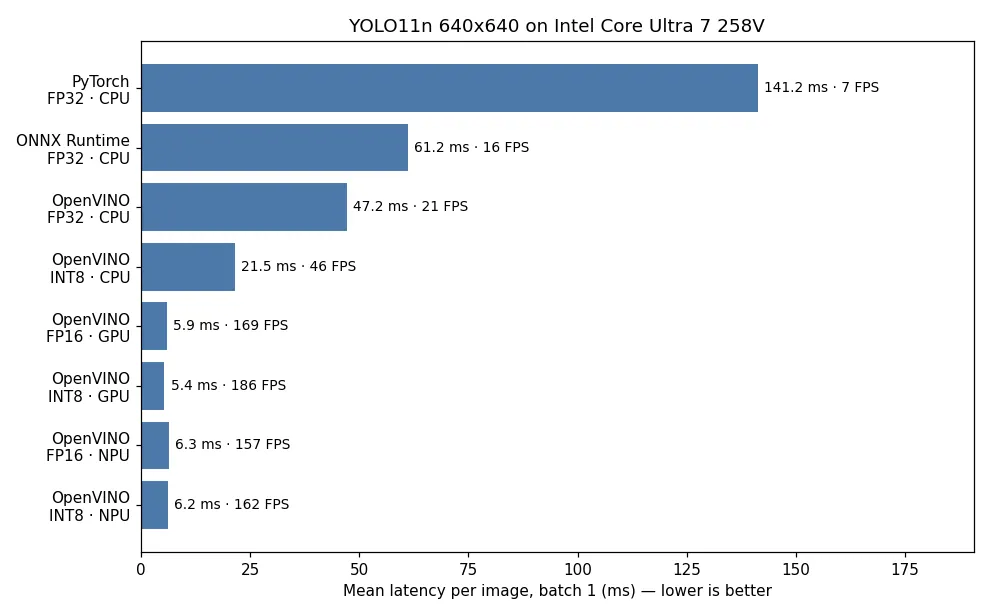
Chart: the latest run (CPU busy with other apps, see below).
Results
YOLO11n, 640×640, batch 1, model inference only (100 timed runs after 15 warm-up runs), OpenVINO 2026.4.
| Runtime | Precision | Device | Idle CPU (2026-10-12) | CPU busy with other apps (2026-10-13) |
|---|---|---|---|---|
| PyTorch (eager) | FP32 | CPU | 79.0 ms (1.0×) | 141.2 ms (1.0×) |
| ONNX Runtime | FP32 | CPU | 42.7 ms (1.9×) | 61.2 ms (2.3×) |
| OpenVINO | FP32 | CPU | 34.6 ms (2.3×) | 47.2 ms (3.0×) |
| OpenVINO | INT8 | CPU | 16.7 ms (4.7×) | 21.5 ms (6.6×) |
| OpenVINO | FP16 | iGPU (Arc 140V) | 4.7 ms (16.9×) | 5.9 ms (23.9×) |
| OpenVINO | INT8 | iGPU | 4.9 ms (16.2×) | 5.4 ms (26.3×) |
| OpenVINO | FP16 | NPU (AI Boost) | 4.6 ms (17.3×) | 6.4 ms (22.2×) |
| OpenVINO | INT8 | NPU | 5.4 ms (14.6×) | 6.2 ms (23.0×) |
The second run happened while Docker and Chrome were using the CPU heavily. CPU paths got 1.3–1.8× slower; the iGPU and NPU barely moved. Offloading inference also protects it from whatever else the machine is doing.
Accuracy: 500 COCO val2017 images, never seen by YOLO11n in training:
| Model | mAP50-95 | mAP50 |
|---|---|---|
| PyTorch FP32 | 0.418 | 0.576 |
| ONNX FP32 | 0.424 | 0.579 |
| OpenVINO FP32 | 0.424 | 0.579 |
| OpenVINO INT8 | 0.423 | 0.577 |
Takeaways
- Moving from PyTorch on the CPU to OpenVINO on the iGPU or NPU is ~17× faster on an idle machine, taking the same model from 13 FPS to over 200 FPS, and the gap grows when the CPU is busy.
- INT8 halves CPU latency (34.6 → 16.7 ms) for a 0.1-point mAP drop (0.424 → 0.423) on held-out images. On the iGPU and NPU it brings little or no speed-up: FP16 is already native there, and for a model this small, fixed overheads dominate.
- The iGPU and NPU are effectively tied; their ranking flips between runs. The NPU’s advantage is power efficiency, which this benchmark doesn’t measure, not raw speed.
- PyTorch scores ~0.006 mAP below the exported models. Likely small differences in how each format is pre/post-processed during validation; not investigated.
Corrections after a code review
- The first version measured accuracy on COCO128, which is part of YOLO11n’s own training data and was also the INT8 calibration set, so it wasn’t a held-out result (it reported a 0.4-point INT8 drop). Accuracy is now measured on 500 unseen val2017 images; calibration stays on COCO128 (disjoint).
- GPU precision is now set explicitly (
INFERENCE_PRECISION_HINT) instead of relying on plugin defaults; the NPU doesn’t accept that option and always computes in FP16. - Installing project 03’s OCR package had silently downgraded OpenVINO to 2024.0, which made INT8 on the
iGPU fail to compile. OpenVINO is now pinned to 2026.4.1 (see
common/ov_compat.pyandsetup_env.ps1).
How it works
- Export: Ultralytics exports YOLO11n to ONNX (graph simplified with onnxslim) and to OpenVINO IR. INT8 uses NNCF post-training quantization, calibrated on COCO128 (train2017) images. No retraining.
- Latency: each runtime gets the same random 1×3×640×640 tensor; we time only the model call,
after warm-up, with the OpenVINO
LATENCYperformance hint. - Accuracy: each exported model is validated on the first 500 COCO val2017 images (converted to
YOLO format by
coco_val_subset()) with the same pipeline, so the numbers isolate the effect of the runtime and precision.
A real-world gotcha: hybrid CPUs
The first run showed ONNX Runtime 2× slower than PyTorch (170 ms), which made no sense. Testing thread counts in isolation:
| ONNX Runtime threads | Latency |
|---|---|
| default (standalone process) | 34.8 ms |
| 4 | 39.8 ms |
| 8 | 166.0 ms |
The Core Ultra 7 258V has 4 performance + 4 low-power cores. With 8 threads, the slow cores
hold everyone back at every synchronization point. In the benchmark process (after PyTorch had
already run), ORT ended up in the 8-thread regime. Pinning PyTorch and ORT to 4 threads
(--threads 4, now the default) fixed it. Lesson: on hybrid CPUs, more threads can be 4× slower,
so always benchmark thread counts.
Run it
.venv\Scripts\activate            # shared environment, from the repo root
cd 19-edge-deployment-benchmark
python benchmark.py                 # export (first run only) + latency + accuracy
python benchmark.py --runs 300 --skip-accuracy
Exports are cached in ../../cv-data/edge/outputs/. Results go to docs/results.json,
docs/results.md and docs/latency.png. The NPU needs the Intel NPU driver (installed with
recent Windows updates on Core Ultra laptops); unsupported devices are skipped and reported.
Limitations
- Model-only latency. Pre-processing (resize/normalize) and post-processing (NMS) aren’t included; in a full pipeline they add a few ms and can become the bottleneck on the iGPU or NPU.
- Batch 1, single stream. Throughput-oriented settings (batching,
THROUGHPUThint, several streams) would raise FPS further on the iGPU. - 500 validation images, not all 5,000: enough to show INT8 doesn’t hurt accuracy, not a full COCO evaluation.
- Latency depends on what else runs. Two runs a day apart differ by up to 1.8× on the CPU (background apps); both are reported rather than picking the better one.
- No power measurement. The NPU’s real selling point (performance per watt) isn’t captured here.
Next steps
- End-to-end pipeline benchmark (decode → pre-process → infer → NMS) and plug it into project 08 (traffic analytics ran at 3.4 FPS on CPU).
- Measure power draw per inference (CPU vs iGPU vs NPU).
Tech stack
Python · Ultralytics YOLO11 · PyTorch · ONNX / ONNX Runtime · OpenVINO 2026.4 · NNCF (INT8)