Receipt Scanner + OCR
Page detection and perspective warp in pure OpenCV, measured on synthetic phone photos with known corners.
Turns a phone photo of a receipt into a flat, clean scan and extracts date and total as JSON. Page detection and perspective correction use classical OpenCV (no deep learning); text recognition uses RapidOCR (PaddleOCR models) running through OpenVINO, ~0.7 s per receipt on a laptop CPU.
Example photos not shown: the synthetic photos use COCO backgrounds (Flickr, mixed licences).
Top: synthetic phone photos with the detected page (green). Bottom: scanner output. The two table photos succeed; the snowy scene fails (white snow merges with the white paper) and in the last one a shadow edge cuts the receipt in half. Failures are kept in the figure on purpose.
How it’s evaluated
SROIE receipts are flat scans with ground-truth fields, so realistic phone photos are generated from them: each receipt is warped with a random perspective (±12° rotation plus tilt) onto a background, with a lighting gradient, a soft shadow, blur, noise and JPEG compression. Generating the photos means the true page corners are known, so the scanner can be scored exactly.
Two settings:
- Table: a plain textured surface, the setup scanner apps ask users for.
- COCO scene (stress test): a random COCO photo as background (snow, walls, cars, animals).
Results
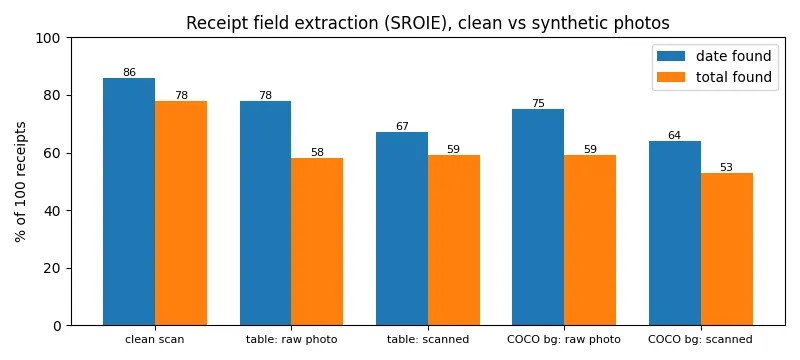
100 SROIE test receipts. Accuracy = exact match of the normalized field with the ground truth.
| Row | Page found (corner error < 3 %) | Date accuracy | Total accuracy |
|---|---|---|---|
| Clean scan (no photo, upper bound) | — | 86 % | 78 % |
| Table photo, raw OCR | — | 78 % | 58 % |
| Table photo, after scanner | 68 % (median error 0.6 %) | 67 % | 59 % |
| COCO-scene photo, raw OCR | — | 75 % | 59 % |
| COCO-scene photo, after scanner | 20 % (median error 10.8 %) | 64 % | 53 % |
When the page is found (68 table photos), the scanner raises total accuracy from 57.4 % to 64.7 %. When it picks the wrong region, it hurts: the crop loses part of the receipt.
| Speed (CPU) | |
|---|---|
| Page detection + warp + lighting correction | ~60 ms |
| OCR (detection + recognition, OpenVINO) | 0.7–1.2 s (varies with other load on the CPU) |
How it works
Scanner (scanner.py)
- Find the paper by color: paper is bright and colorless, so score = brightness − saturation (HSV). Several global thresholds plus adaptive (local) thresholds produce candidate masks; adaptive thresholds survive lighting gradients and soft shadows.
- Pick the best page: for each blob, fit a quadrilateral (convex hull → polygon approximation) and keep the largest blob that fills its quadrilateral almost exactly. Shapes no page could have are rejected: touching the image border, concave, corners outside 55–125°, slivers.
- Fallback: Canny edge contours if no color candidate passes.
- Warp + clean: perspective transform to a straight-on rectangle, then divide by a blurred background estimate to remove shadows and uneven lighting.
OCR + fields (receipt.py)
- RapidOCR detects and recognizes text boxes.
- Deskewed line grouping: the dominant text slope is measured from the boxes themselves, and boxes are grouped into lines along that slope. On a slightly rotated receipt, prices in the right column otherwise land on the next line.
- Rules: date regexes (tolerating OCR gluing the time onto the year:
15/01/201911:05AM) and a priority score for total lines:payable/grand total>total incl. GST> plaintotal, excluding subtotal, tax-only, quantity, cash and change lines.
The debugging story (what moved the numbers)
| Change | Measured effect (same receipts before/after) |
|---|---|
| ONNX Runtime → OpenVINO backend for RapidOCR | OCR 5.2 s → 0.5 s per receipt (~11×), same text |
| Edge contours → color + adaptive thresholds + shape checks + “page must not touch the image border” | 6-photo plain-background check: pages found 2/6 → 5/6. The border rule fixed background regions framed by the photo edge being picked as “pages” |
| Date regex without a trailing word boundary + total-line priority (instead of “skip any line containing GST”) | 20-receipt check on clean scans: date 70 % → 95 %, total 45 % → 65 % |
| Median-height + deskewed line grouping | 100 table photos, raw OCR: total 28 % → 52 %; clean scans: total 77 % → 79 % |
Amount parser handles thousands separators (1,234.00 was read as 234.00; found in a code review) | Clean-scan total 79 % → 78 %, table raw 52 % → 54 % (a few receipts change either way) |
Amounts no longer glued across spaces (3.00 6.00 was read as 3006.00; found by a unit test) | Final numbers above: table raw 54 % → 58 %, COCO scanned 43 % → 53 %; clean scans unchanged |
Data
- Receipts: ICDAR 2019 SROIE test split (361 receipts; first 100 used),
CC BY 4.0, from the Hugging Face mirror
jsdnrs/ICDAR2019-SROIE. Fields: company, date, address, total. - Backgrounds: COCO val2017 images (shared with project 16) for the stress test.
- Location:
../../cv-data/receipts/(not committed).
Run it
.venv\Scripts\activate            # shared environment, from the repo root
cd 03-document-scanner-ocr
python evaluate.py --n 100        # ~7 min on CPU
python app.py                     # web demo: photo → scan → JSON
What I learned / what didn’t work
- Classical page detection is fragile on busy backgrounds. It works when paper contrasts with the surface (68 % on a table, sub-1 % corner error when it works) and fails when the background is also white (snow, walls) or a strong shadow edge splits the page. A small learned segmentation model (e.g. a U-Net trained on synthetic photos like these) would be the next step.
- The biggest OCR gain came from layout, not vision. Grouping words into the right lines (deskewed) did more for total accuracy than the scanner itself.
- Scanning slightly lowers date accuracy (78 % → 67 % on table photos). Likely causes: the lighting-correction step thinning small digits, or resolution lost in the warp. Not yet isolated.
- Rule-based extraction tops out around 80 % even on clean scans. Layouts vary too much; a layout-aware model (LayoutLM, Donut) learns field positions instead of keywords.
Next steps
- Learned page segmentation for busy backgrounds; ablation of the lighting-correction step for dates.
- Replace rules with a small layout-aware model for field extraction (SROIE train split: 626 receipts).
- Evaluate on real phone photos of receipts.
Tech stack
Python · OpenCV · RapidOCR (PaddleOCR models) · OpenVINO · pandas · Gradio